Selasa, 02 Juli 2013
Grow the Celebrity Tomatoes You Crave in a Container
How would you like to grow large, juicy, and delicious celebrity tomatoes in your garden? What if I told you that you could grow these tomatoes without even owing a yard? That’s right - by using a container garden. But there are a handful of things you’ll need to remember to ensure you have a great harvest of tomatoes… Celebrity tomatoes are determinate. This means that they’re the short, bushy type. Quite a good choice for containers, actually. For starters, you needn’t worry about staking your tomato plants. But it also means that you’ll need a little more space for your tomato plants. Read on though, because with proper pruning, you won’t even notice this extra space requirement. Firstly, let’s talk about how to choose the correct container size for your celebrity tomatoes. Keep in mind that these tomatoes can grow to quite a large size, so I suggest that you either use a large growing pot, or grow just a single tomato plant per container. Either way, the major consideration here is to give your tomato plants sufficient growing space. In order to grow large celebrity tomatoes, add a modest amount of nutrients to your plants diet. This can be in the form of some extra organic compost, or even a liquid based fertilizer. A liquid based fertilizer is easier to use, seeing that you can determine the required dosage from the instructions on the label. Organic compost does have the ‘all natural’ actor though, and that may play a role in your decision making. Either way, use a good fertilizer! It’s pointless having your celebrity tomatoes growing large but being completely bitter. Sunshine can help a great deal here. Ensure that your tomatoes receive a. if you’re growing your celebrity tomatoes in a container garden; try to place the container in a spot that receives a good sunshine for most of the day. On this note, you can allow your tomatoes to ripen on the tomato bush for a while, abut then pluck them and allow them to ripen in the sunshine. Since celebrity tomatoes are naturally quite bushy, you need to prune your plants sufficiently to ensure that they take up less space, and to increase the amount of nutrients available to the rest of the plant. Prune off extra stems and leaves that simply take up space and waste nutrients. This way, your tomato bush will more compact, and the fruit it produces will grow larger and to better health. Celebrity tomatoes can grow to quite a large size, and they can be grown in large containers if you don’t have a full sized backyard garden. Just ensure that you give each tomato plant enough space to grow well, and that you add a good helping of nutrients to their diets.

Minggu, 30 Juni 2013
Sequoia Progress in Indiana with the Groasis Waterboxx
We have always been interested in big trees, and have planted several (4) Giant Sequoias (Sequoiadendron giganteum) outside where we live in Indiana, only to see all of them die. When we started Dew Harvest® LLC, we decided to use one Groasis Waterboxx to plant a Giant Sequoia, hoping that the Waterboxx would overcome the dry Indiana summers that killed my previous 4 trees. The Sequoia is very water loving, and does not tolerate long periods of drought. Below you see pictures of both the Sequoia immediately after planting in mid May and progress since then 6 weeks later (for reference, the lid of the Waterboxx is 20 inches in diameter).
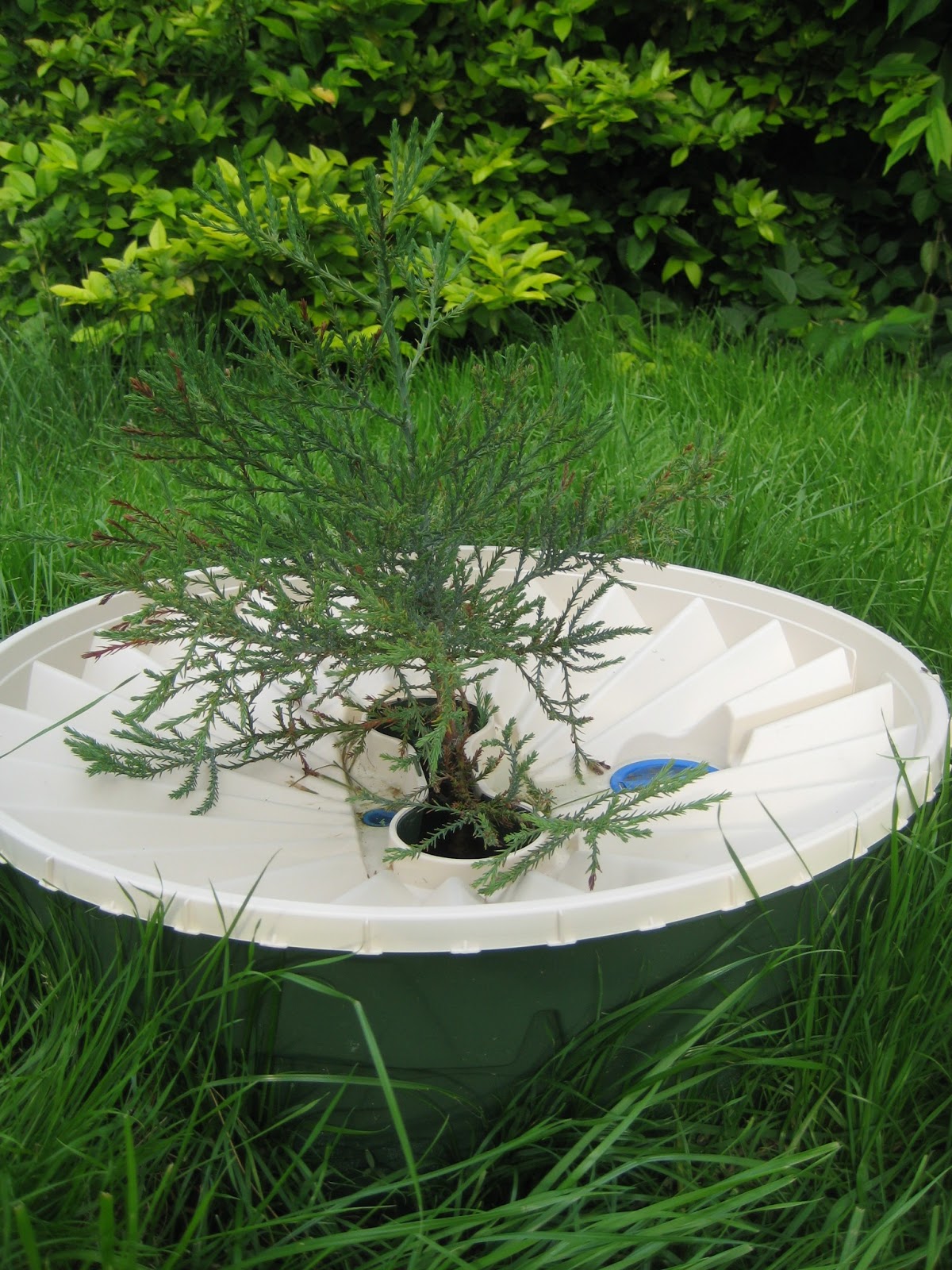 |
| The Sequoia seen laterally at initial planting (again approximately 2 years old). Some brown is evident from winter die back. |
 | ||||||
Sequoia after 6 weeks growth with the Waterboxx (almost doubled in size) while the grass around the Sequoia has died back from lack of rain. No water was added to the Waterboxx except that added by dew and rain naturally. Note: Orientation of photo is flipped 180 degrees as evidenced by blue cap in Waterboxx lid position. The lighter blue green color is indicative of new growth.
 |


Sabtu, 15 Juni 2013
Hellloooo
It has been ages, simply ages - but better late than never for a quick update. I've been busy teaching and studying, so there's been little time to garden, let alone write. I've stolen a few minutes away from the marking to make a quick harvest and an even quicker update.

We just harvested 2kgs of Jerusalem artichokes. Yes that's 2 KILOS! That's once the dirt had been washed away too. Amazing and all from just one pot. We're going to make gnocchi from some tonight, and roast the others up with dinner later this week. Delicious.
Kale, Silverbeet, lettuce and spinach are all growing well in this chilly winter weather.
Over the summer we harvested a metric tonne of tomatoes, and are already planning the Spring tomato garden.
I'll try and post more often, I promise :)

We just harvested 2kgs of Jerusalem artichokes. Yes that's 2 KILOS! That's once the dirt had been washed away too. Amazing and all from just one pot. We're going to make gnocchi from some tonight, and roast the others up with dinner later this week. Delicious.
Kale, Silverbeet, lettuce and spinach are all growing well in this chilly winter weather.
Over the summer we harvested a metric tonne of tomatoes, and are already planning the Spring tomato garden.
I'll try and post more often, I promise :)
Selasa, 11 Juni 2013
Replant the Earth!
Replant the Earth!!!
Welcome to the Arid Arborist by Dew Harvest
This blog will be devoted to efforts to grow trees and other plants using a ingenious device called the Groasis Waterboxx. The Waterboxx was developed in Holland by a man (Pieter Hoff) who wanted to replant the Earth with trees, scrubbing our air of carbon dioxide and stopping the seemingly unstoppable creep of the desert. The author's goal is much more modest, namely to plant trees wisely using the Waterboxx and to document both our results and those of customers of Dew Harvest® LLC (where the Waterboxx is sold in the U.S.). Living in the Midwest, we have seen the worst drought in anyone's memory the last 3 summers, which is deeply troublesome to us. A large number (perhaps 10%) of the mature inner city trees have died from this drought, with almost all newly planted trees suffering and many dying. To us, the only option to deal with the consequences of this drought (if you want to prevent a descending spiral of dead trees leading to lack of shade and less humidity leading to worse heat leading to dead trees . . . ) is to plant trees the way nature intended with the Groasis Waterboxx.
 |
| The Waterboxx with an oak, grown from seed. The oak has been planted in Northern Indiana with the Waterboxx and continues to grow. Since the founding of Dew Harvest and launching of this blog, we have had great success growing trees (from dwarf pear trees to Giant Sequoia) to growing vegetables like pumpkins. The Groasis Waterboxx is deceptively simple looking, but relies on many natural principles. These are explained in the video below. Be the first in your area to start growing plants with the Groasis Waterboxx. If you would like to learn more about the Waterboxx, read our other posts or visit the main Dew Harvest® website. You can see all our blog posts about planting trees with the Waterboxx here. We would love to hear your comments below - to leave one, please click on "Comments". |
Jumat, 21 Desember 2012
Tomato fest 2012
The tomato season it upon us, and I was almost to busy to notice! With uni taking up pretty much all my time, I've been neglecting my other duties. The lovely other half has been tending to the balcony garden and pulling in a wonderful harvest. Photos to come soon. But in the mean time here is a hint of the awesomeness that is tomatofest 2012:
Rabu, 28 November 2012
Toooommmaaattoooeesss
Ok, I lie a little, it really is just one ripe tomato, and it is long gone now but it is, indicative of things to come! I wanted to post this for harvest monday but TFA has been keeping me busy. I snuck a spare 5 minutes between readings to post this picture of the FIRST ripe tomato on the balcony garden for 2012. It was eaten on Sat, 24th November.

Not the earliest tomato we've had, but it was certainly delicious. There is another cherry tomato ripening on the same tumbler hanging pot bush, and I am hopeful that some of the larger varieties follow suit soon.

Not the earliest tomato we've had, but it was certainly delicious. There is another cherry tomato ripening on the same tumbler hanging pot bush, and I am hopeful that some of the larger varieties follow suit soon.
Senin, 19 November 2012
Tomatoes, Friends, Help
First of all I send my heart out to Missy Piggy who lost her tomatoes to attack by caterpillars blossom end rot. Time for a caterpillar armageddon methinks, as well as some crushed eggshells in the dirt to help the blossom end rot. Finger crossed you get more (or at the plants gone??? there's still time to replant.)
Another friend has been growing Siberian tomatoes here in Melbourne. Now, I know a fair bit about tomatoes, how to grow them, how to eat them, and how to fix a few problems. But I was perplexed by my friend's tomato problem and thought you could help. What's up with this one?:

It has been growing well so far in a raised bed, but n ow has these crinkly bits. Usually rolled up leaves happen at certain times of the day, and it is simply a moisture loss thing, but I've never seen this before. is it even a problem and if so what is it? Tomato-knowitalls to the rescue!
Another friend has been growing Siberian tomatoes here in Melbourne. Now, I know a fair bit about tomatoes, how to grow them, how to eat them, and how to fix a few problems. But I was perplexed by my friend's tomato problem and thought you could help. What's up with this one?:

It has been growing well so far in a raised bed, but n ow has these crinkly bits. Usually rolled up leaves happen at certain times of the day, and it is simply a moisture loss thing, but I've never seen this before. is it even a problem and if so what is it? Tomato-knowitalls to the rescue!
Langganan:
Postingan (Atom)