Minggu, 30 Juni 2013

Sequoia Progress in Indiana with the Groasis Waterboxx


We have always been interested in big trees, and have planted several (4) Giant Sequoias (Sequoiadendron giganteum) outside where we live in Indiana, only to see all of them die.  When we started Dew Harvest® LLC, we decided to use one Groasis Waterboxx to plant a Giant Sequoia, hoping that the Waterboxx would overcome the dry Indiana summers that killed my previous 4 trees.  The Sequoia is very water loving, and does not tolerate long periods of drought.  Below you see pictures of both the Sequoia immediately after planting in mid May and progress since then 6 weeks later (for reference, the lid of the Waterboxx is 20 inches in diameter).

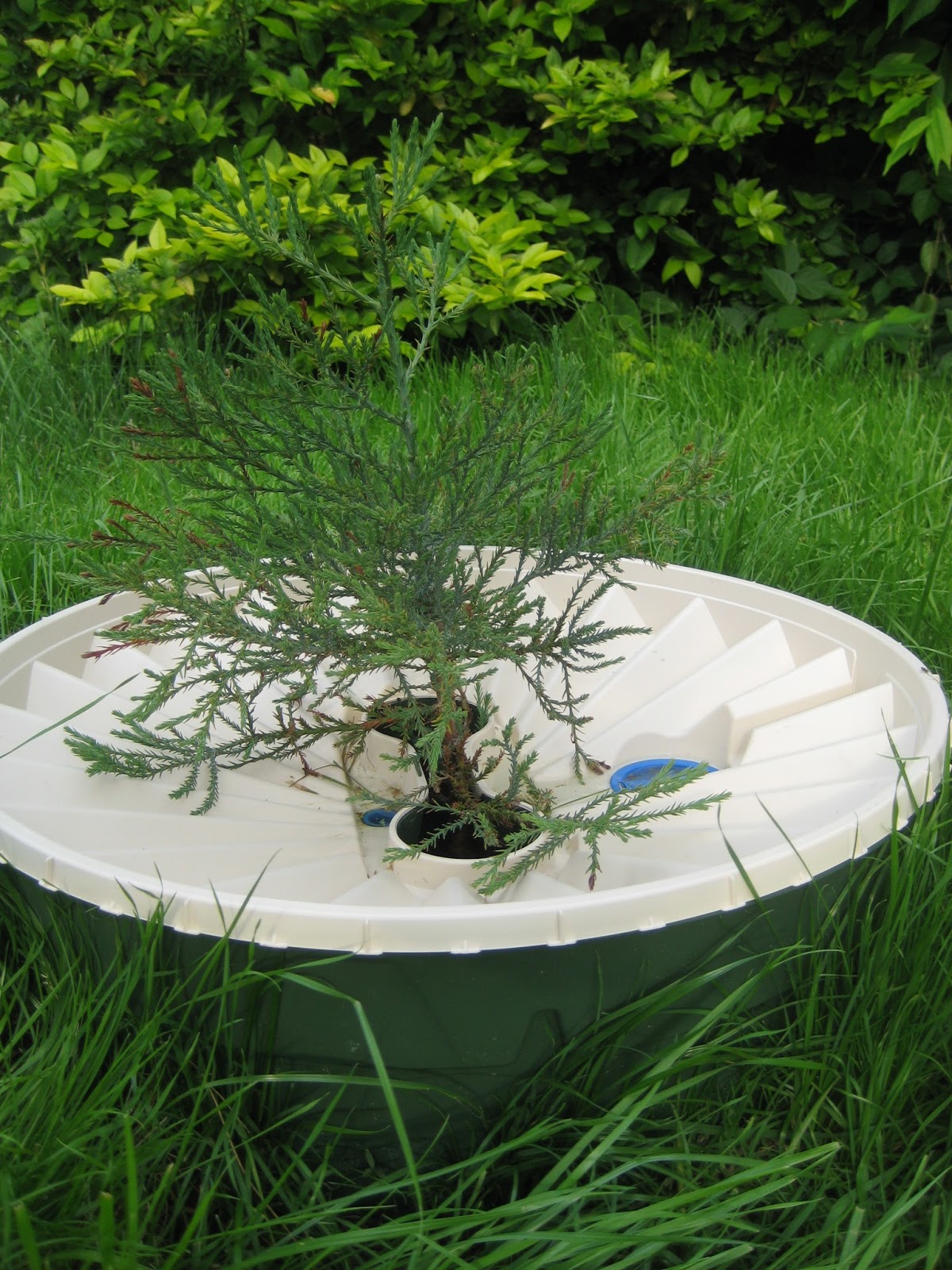
The Sequoia seen laterally at initial planting (again approximately 2 years old).  Some brown is evident from winter die back.

Sequoia after 6 weeks growth with the Waterboxx (almost doubled in size) while the grass around the Sequoia has died back from lack of rain.  No water was added to the Waterboxx except that added by dew and rain naturally.  Note: Orientation of photo is flipped 180 degrees as evidenced by blue cap in Waterboxx lid position.  The lighter blue green color is indicative of new growth.

The Sequoia after 6 weeks with the Waterboxx (approximately doubled in size in 6 weeks, after 2  years of slow growth).  Again, the  grass around the Groasis Waterboxx is dying back from lack of consistent rainfall.  Again, the lighter blue green is new growth, and no brown is evident.
The Sequoia after approximately 2 months, continues growing in height as well as width.  The large amount of light green indicates the rate at which the tree is growing.  The box will be left on over winter, as it provides a blanket of water which will only slowly change temperatures and protect the base of the Sequoia from drying out.  The design of the Waterboxx means that it will not break when the water in it freezes, but may loosen the lid (the ice will expand upward, not outward).


Sequoia after approximately 2 months of growth with the Waterboxx and no external watering (no water has been added to the box except dew and rain, which have kept the box completely full).  You can see that the surrounding grass continues to die back from lack of water, but the irrigating and cooling effects of the Waterboxx keep the sequoia growing without any browning.  This tree will soon be able to grow on its own, but we will leave the Waterboxx on it over winter to prevent the drying winter winds from killing the young tree.


The water level is only down approximately 1 cm (in a ~25 cm high basin) after one whole month with less than 1 inch of rainfall.  The morning dew is funneled into the basin, and this prevents the basin from emptying even though it continues to water the healthy growing tree (Photo from August 28,2013)


The Sequioa 3 months after initial planting with the Waterboxx.  The tree remains green even though the surrounding grass has died from lack of rainfall.  

Besides a very dry summer, we had the harshest winter in living memory.  Just as the Waterboxx provides consistent sustaining water in the summer drought, its basin protects the trunk of the tree from drying winds.  The image below shows the Waterboxx on January 10, 2014, during the Polar Vortex (with temps down to -13 degrees Fahrenheit).  


As you can see, the Waterboxx is wonderfully effective at growing water loving trees (or trees in dry areas) even if there is not enough water to sustain such plants as grass.  The Waterboxx accomplishes this by storing dew, collected almost every night, in its basin and slowly releasing it through a wick into the soil below.  The basin serves as a type of plastic mulch, preventing evaporation of the water during the day.  The Waterboxx will need to be removed before the Sequoia is too large to fit through the central opening, which will likely be next spring.  The Waterboxx can stay around the tree overwinter, and will not break if the water inside it freezes.  In this way, it will also form a blanket for the Sequoia, which is susceptible to drying winds (most experts advise burying the Sequoia in straw in the winter). 


The images above show the health, size, and continuing growth of the Sequoia in the late spring, approximately one month following removal of the Waterboxx.  The Sequoia generally browns out in early spring (see brown above) only to add significant new growth later that same season.  The Sequoia is now ~2 feet tall (23 inches) and about 20 inches wide in this photo.


This photo was taken on July 18, 2014, 3 months after Waterboxx removal.  This Sequoia has not had any irrigation or artificial watering of any type (it did have a pan around it, not shown in this picture, to funnel water to the base).  It is now almost 30 inches wide and about as tall.  It clearly will survive now due to the deep Waterboxx induced roots.  


The Sequoia is seen above on October 4, 2014.  Here you can see it is over one yard tall now (about 38 inches in total height.  It has continued to have new growth throughout the late summer.  
Growing up in Indiana (where the tallest tree is rarely 100 feet tall), the author became intrigued with the idea of Sequoias that can grow 300 feet tall and live for thousands of years.  We were disappointed with our consistent failure to establish one of these trees - until we tried the Waterboxx.  We now hope to be able to establish small woods with Sequoias, sequestering carbon and adding incredible beauty to our Hoosier landscape.  

Be the first in your area to start growing trees (including perhaps Sequoias) with the Groasis Waterboxx. As always, you can learn more about the Groasis Waterboxx and buy one (or several) at Dew Harvest® LLC.  

You can see all our blog posts about planting trees with the Waterboxx here. We buy our Sequoias from our friend Joe Welker at Giant-Sequoia.com.  We would love to hear your comments below - to leave one, please click on "Comments". 

Sabtu, 15 Juni 2013

Hellloooo

It has been ages, simply ages - but better late than never for a quick update. I've been busy teaching and studying, so there's been little time to garden, let alone write. I've stolen a few minutes away from the marking to make a quick harvest and an even quicker update.


We just harvested 2kgs of Jerusalem artichokes. Yes that's 2 KILOS! That's once the dirt had been washed away too. Amazing and all from just one pot. We're going to make gnocchi from some tonight, and roast the others up with dinner later this week. Delicious.

Kale, Silverbeet, lettuce and spinach are all growing well in this chilly winter weather.

Over the summer we harvested a metric tonne of tomatoes, and are already planning the Spring tomato garden.

I'll try and post more often, I promise :)

Selasa, 11 Juni 2013

Replant the Earth!

Replant the Earth!!!
Welcome to the Arid Arborist by Dew Harvest

This blog will be devoted to efforts to grow trees and other plants using a ingenious device called the Groasis Waterboxx.  The Waterboxx was developed in Holland by a man (Pieter Hoff) who wanted to replant the Earth with trees, scrubbing our air of carbon dioxide and stopping the seemingly unstoppable creep of the desert.  The author's goal is much more modest, namely to plant trees wisely using the Waterboxx and to document both our results and those of customers of Dew Harvest® LLC (where the Waterboxx is sold in the U.S.).  Living in the Midwest, we have seen the worst drought in anyone's memory the last 3 summers, which is deeply troublesome to us.  A large number (perhaps 10%) of the mature inner city trees have died from this drought, with almost all newly planted trees suffering and many dying. To us, the only option to deal with the consequences of this drought (if you want to prevent a descending spiral of dead trees leading to lack of shade and less humidity leading to worse heat leading to dead trees . . . ) is to plant trees the way nature intended with the Groasis Waterboxx.
The Waterboxx with an oak, grown from seed.  The oak has been planted in Northern Indiana with the Waterboxx and continues to grow.

Since the founding of Dew Harvest and launching of this blog, we have had great success growing trees (from dwarf pear trees to Giant Sequoia) to growing vegetables like pumpkins.  


The Groasis Waterboxx is deceptively simple looking, but relies on many natural principles.  These are explained in the video below.
  

Be the first in your area to start growing plants with the Groasis Waterboxx.  If you would like to learn more about the Waterboxx, read our other posts or visit the main Dew Harvest® website.  

You can see all our blog posts about planting trees with the Waterboxx here. We would love to hear your comments below - to leave one, please click on "Comments". 

Jumat, 21 Desember 2012

Tomato fest 2012

The tomato season it upon us, and I was almost to busy to notice! With uni taking up pretty much all my time, I've been neglecting my other duties. The lovely other half has been tending to the balcony garden and pulling in a wonderful harvest. Photos to come soon. But in the mean time here is a hint of the awesomeness that is tomatofest 2012:


Rabu, 28 November 2012

Toooommmaaattoooeesss

Ok, I lie a little, it really is just one ripe tomato, and it is long gone now but it is, indicative of things to come! I wanted to post this for harvest monday but TFA has been keeping me busy. I snuck a spare 5 minutes between readings to post this picture of the FIRST ripe tomato on the balcony garden for 2012. It was eaten on Sat, 24th November.


Not the earliest tomato we've had, but it was certainly delicious. There is another cherry tomato ripening on the same tumbler hanging pot bush, and I am hopeful that some of the larger varieties follow suit soon.

Senin, 19 November 2012

Tomatoes, Friends, Help

First of all I send my heart out to Missy Piggy who lost her tomatoes to attack by caterpillars blossom end rot. Time for a caterpillar armageddon methinks, as well as some crushed eggshells in the dirt to help the blossom end rot. Finger crossed you get more (or at the plants gone??? there's still time to replant.)

Another friend has been growing Siberian tomatoes here in Melbourne. Now, I know a fair bit about tomatoes, how to grow them, how to eat them, and how to fix a few problems. But I was perplexed by my friend's tomato problem and thought you could help. What's up with this one?:


It has been growing well so far in a raised bed, but n ow has these crinkly bits. Usually rolled up leaves happen at certain times of the day, and it is simply a moisture loss thing, but I've never seen this before. is it even a problem and if so what is it? Tomato-knowitalls to the rescue!


Minggu, 18 November 2012

Harvest Monday

Today we harvested ...


IF ONLY! That deliciousness isn't quite ready yet. I doubt I'll see any of the tomatoes ripen before I head off for my Teach for Australia 6 week Intensive, but a girl can only dream. We have cherry ones too:


But we have been easting other yummy things, like some small bits of celery and a tonne of lettuce. Microgreens in every salad and garlic in the cooked things (I'm allergic to raw garlic.)


There should be some amazing havest monday posts in my future because we have 28 tomatoes, 3 golden zucchini, 3 white cucumbers, 2 laden apple trees, a white eggplant, a black capsicum and many, many pots of celery, lettuce, herbs and more. Not bad for a little balcony garden.

Thanks to my lovely other half for the great photos.

If you want to see other people's Monday harvests head on over the Daphne's Dandelions.