Overnight we have had rain, not a lot, just a light and steady smattering which means I won't have to water today and possibly even tomorrow (depending on if the sun comes out and if the wind stays away.) This gives me a good 20 minutes in my day in which to blog. With the final few memoirs for the thesis to be read and significant other work on my life has been busy. A little too busy for a regular blog and even too busy to remember to photograph things in a timely manner. Time management skills can only work for 24 hours in a day and until I master the art of getting 36 hours out of a day I will have to make to with these little snatches of spare time. But yay to now getting to post.
I love when it rains. Just look at the picture above of my lovely little chilli all covered in drops. Not only is the hand watering a non-necessity, I get to sit by my large windows and watch the rain fall onto the garden. Drops collecting on the green (and slightly yellow) plants, pooling into their soil. A few hours later they look taller, stronger, happier. Rain just has this natural boost for plants that they simply cannot get from tap and/or grey water. Mind you this summer has been the wettest on record, and it hasn't been that good for many gardeners and farmers. Some had their crops and top soil washed away while others like stone fruit growers were damaged by wind and hail. It has also caused a few problems in the little balcony garden, such as increased risk of powdery mildew, problematic pollination and issues with drainage. What are these problems, how have I gone about fixing them and what do these excessively watery days mean for balcony gardeners?
1. Powdery Mildew
In a warmish moist environment powdery mildew is pretty much a given. Zukes, Cukes and others in that family usually fall victim to it. The picture below shows the beginning of it on a yellow zucchini (if you strain your eyes.) White dots appears on leaves, under leaves and on stems. They slowly defoliate the plant and kill it.
Though hard to prevent it is pretty easy to control. I have always used a milk spray, one part whole milk (skim, lactose free which I have in my tea won't cut it, it has to be the full cream stuff) to 9 parts water. This ratio makes it work for my balcony garden though you might have to tweak it for yours. Spray all affected areas including the underside of leaves and stems on your plants in the morning and the evening and the powdery mildew tends to fix right up. It also helps to remove any really badly affected leaves and dispose of them (no composting of those or it wont help.) While the weather is favourable to powdery mildew you may have to keep spraying but it isn't too much hassle and the small amount of milk in it means it won't smell too bad.
2. Pollination Issues
Plants need to be pollinated to produce the good bits, the yummy bits, the foodie bits. The tassles from corn need to meet with the silks to make heads of corn. The eggplant and tomato flowers need to be shaken at just the right speed and at just the right time to mingle the male and female bits. For cucumbers and zucchinis you need to introduce Mr male flower to the bits of Mrs female flower (she is the one with the baby zuke or cuke attached) for anything to happen. Wet weather isn't good for this. Corn particularly wont set well in the rain. But what to do besides a backwards rain dance? The best policy is just to keep trying. Hand pollinate again and again. Perhaps save some of the bits like the corn tassles or the male flowers of cucurbits in the fridge overnight and then see if the weather has improved thus hand pollinate the next day. Rain doesn't completely stop pollination from happening, it just gets in the way. So when wet weather sets in practice some hand pollination and time it well, otherwise you mightn't get much from your balcony crops.
3. Drainage.
Drainage, good drainage that is, has to come from the very beginning. It can be rectified later on if needs be but it is tricky and some plants wont survive the move. My advice is make sure you have the right pot for the right thing, and make sure it is big enough. If it isn't a self watering pot make sure to include plenty of drainage holes. If these holes are only on the bottom then make sure the pot is up away from the ground or off a surface otherwise they get closed over. Make sure you have enough holes, but don't go overboard otherwise you will lose too much water. Plates underneath the pot are a great way to collect water but it is best to raise your pot off them again as otherwise it could lead to drainage issues.
The plant below, my lime tree, doesn't drain that well and at times the new growth will wilt when there is too much water (and indeed when there is too much sun but that is a whole different matter.) See how the supple green limbs are hanging loose in the picture below. That shows poor drainage.
In the bottom of your pots add things like stones or foam or something to add pockets for drainage. I prefer the latter as it is cheap, light and effective.
In this weather, for balconies, make sure your drainage pipes are clear of debris. Dirt, leaves and other bits a pieces can accumulate in them and black them making your balcony a virtual swimming pool and dooming your plants.
Overall these problems are seasonal, and not always a summer issue. But with the world's weather wildly changing it is good to know what to do in these times. Do you have any other issues that come with the wet weather? Any other solutions to the problems listed here?
Sabtu, 26 Februari 2011
Sabtu, 19 Februari 2011
Genetic control of fruit stripes in tomato
Over the last few years we’ve made many dozen crosses between various striped types and the best tasting heirlooms. Most of the striped parents were from Brad Gates at Wild Boar Farms, but there were others too. In studying the F1 and F2 progeny from these crosses, reading what is in the literature, and listening to the experience of a couple respected colleagues – here’s what we’ve learned about genetic control of stripes in tomatoes.
We believe there are at least three different patterns for fruit striping in tomato, all under different genetic control. All three result in tomatoes that are striking in appearance, and since there seems to be no relationship between fruit stripes and taste or horticultural traits, a tomato can be both great looking and great tasting.
| homozygous gs in unripe fruit |
| gs - yellow stripes on red |
| gs = green stripes on brown |
![]() |
| F2 segregates |
![]() |
| Fs drawing (from Keith Mueller) |
The fruit stripe gene (Fs) causes dark green radial stripes opposite the fruit locules. These radial stripes tend to fade as the fruit matures. I have only seen radial stripes on ripe fruit on green flesh (gf) types, for example Indian Stripe or Arbuznyi. An exception to this may be with Aft fruit, where again anthocyanin appears to preferentially accumulate in the stripes (e.g. Siberian Tiger and Bengal Tiger). I’ve only seen this one example on a red/orange Aft fruit, so there’s more to learn here. Expression of the Fs trait is highly dependent on environment - a real frustration when it comes to breeding for these striking radial stripe patterns.
![]() |
| Fs in apricot background, unripe fruit (Keith Mueller) |
We believe there is a third unrelated striping pattern that is evident in some bi-color types. These broad (often red or orange) stripes radiate in a regular pattern from the blossom end, and I’ve only seed this in orange/red/yellow or green/red bi/tri-color type fruit. Unlike gs and Fs, these stripes are not evident on unripe fruit. The color comes from below, rather than in the epidermis. I think the Wild Boar Farms varieties Beauty King, Beauty Queen and Berkeley Tie Dye (BTD) are examples of bicolor types that may have both gs and radial bicolor striping (note: Gates says Beauty King was derived from a cross between the bicolor Big Rainbow and Green Zebra). I have not been able to find much in the literature on heritability of the bicolor trait in general or of this unique radial striping pattern – but based on F2 progeny from crosses with BTD and BK there is likely more than one gene involved, and the traits tend to both be recessive. This summer we’ll have several unrelated breeding lines segregating for this pattern of fruit coloration – so more to come later.
| Yellow/Orange bicolor w/ radial stripes |
![]() |
| Butt end of BTD type bicolor |
![]() |
| Cross section of BTD type bicolor |
The interaction between these three independent traits, each resulting in a unique pattern of stripes on tomato fruit, and the effect of interactions with other genes (e.g. gf and y) on these traits make for a wide variety of striped phenotypes, and complicated genetics. Over the next few years it will be fun sorting out segregating progeny from crosses we’ve made between parents expressing these various genes.
| 2011 crosses |
Senin, 14 Februari 2011
Harvest Monday: Red for Hallmark Day
Another Harvest Monday rolls around way too quickly. And in keeping with my least favourite day of the year - Hallmark Day - the produce was lovey dovey red. More berries this week and more chillis than I knew what to do with. At the moment they are in the freezer waiting to jump into a nice hot chilli con carne when the weather seems appropriate.
All that red was all right, I suppose but the the piece de resistance this week had to be the fig. My first fig. Mr Fig twig was generous enough to give me an early sample and he didn't disappoint. Into a sandwich it went, with proscuitto and lettuce. Totally delicious.
This coming week there will be another eggplant harvest and maybe even a cucumber. I only planted them a little under a month ago but they are already fruiting!!!
How was your harvest this week? For more yummy stuff from the ground see Daphne's Dandelions harvest monday round up.
Senin, 31 Januari 2011
A Berry Little Harvest Monday
Bit of a smaller harvest this week, with only a few staples left in the sun scorched garden. Beautiful berries of the strawberry kind went into my breakfast this morning. There were both wild versions of this little red wonder and some Hokowase strawberries. Usually I just snack on them as I garden but this time there were enough to go in my breakfast fruit salad.
Silverbeet is continual, even though I cut it to the ground just a month ago! It goes in many dishes and adds extra nutrients.
Eggplants, well I showed you them the other day and here they are harvested. These went into a wonderful little pasta dish.
Speaking of pasta, the last of the pumpkins I harvested a while ago was used up in a delicious pesto pasta dish.
And that is pretty much it for the moment. If you want to see other harvests pop on over to Daphne's Dandelions. I looks forward to harvesting chillies this week and int he future some figs and some more eggplants. The corn, the new corn that is, is a fair way off but I will post about that little experiment soon.
And on slightly different matters, if you can solve my friend's mutant tomato dilemma I posted about yesterday please, please, please add your advice. :)
Minggu, 30 Januari 2011
Mutant 'matoes and Plan 9 from the Frankenspace
I love B grade horror films of the yesteryear. Not 1990s ones though I guess in 2011 we can almost count that yesteryear. While the zombie runs in the 1970s are almost there it is not quite the era I am meaning. These films, almost more z grade than b grade populated the screens in eras earlier, where black and white were the order of the day. These I find to be pretty good on occasions, particularly when watched in the dark on a stormy summer night with popcorn and a sav blanc for good measure. Viewing triffids invading the earth, or Bela Lugosi doing all that he can to be typecast in his most senior moment of life or going even further back to Boris Karloff in his Frankenstein turn. And it is with these types of films in mind that I bring you the attack of the mutant tomatoes. Late one night, in a garden not unlike your own, these creatures are lurking ...
Ok they aren't in your garden. They're not even growing on the balcony. They are in a friend, Miss R's garden in Adelaide. It was, at one point, a tomato seedling but now it is unlike anything I've ever seen. The other seedlings from the same punnet are growing fine, though suffering a bit from the heat whereas this little man, well, he is growing in a uniquely grotesque way. Miss R feared it was a disease and worried for her other tomatoes but I am pretty sure this is just a seed gone wrong, mutated into the frankenstein of tomato plants and harmless though fascinating. A mish mash of plants, supposedly a tomato but with the growing habit of something entirely different. The other option is that it is a triffid come to claim the earth, the first in a wave of many, but that might be wrong too. So who is right? Odd new disease or mutant 'mato? Does anyone have any other suggestions? Should she pull it or should she leave it to see what mutant offspring it will probably never have?
Jumat, 28 Januari 2011
Fairytales in the Balcony Garden
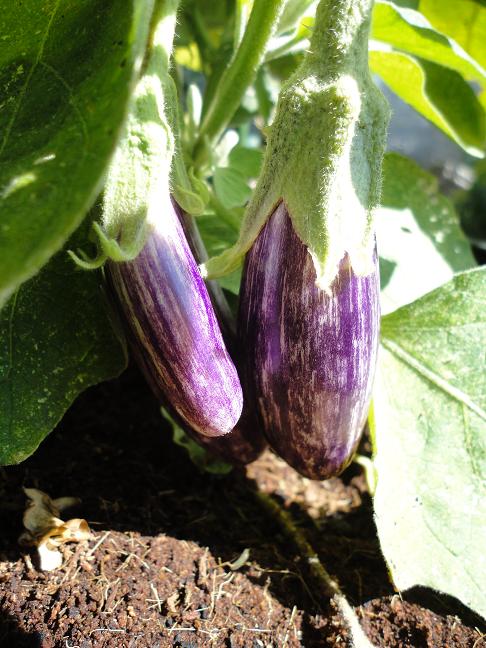
I love eggplant. Be it cooked up in sauces or in pasta or turned into a dip, I find it such a treat. I even grew it over winter last year in the balcony garden and it did well. This year I went with a different variety of eggplant, fairytale eggplant. While these did not grow as large as their bonica mates, they certainly made up for their lack of size with prettiness. Just look at those purple and white stripes!
The taste is a bit milder but a bit crisper if that makes any sense. I'll certainly grow these again next year, in bigger pots if I am feeling nice. They like a fair bit of water, and the bugs get into them and cause damage but for the colour and taste alone I am smitten.
Minggu, 16 Januari 2011
Harvest Monday Extravaganza
I finally found my camera cord and uploaded the goodies so here is a parade of recent harvests and this week's harvest. It even has some golden globes! These harvests date back to just before Christmas, even so this little balcony garden has produced a lot.
Here was the pre-Christmas harvest and it saw the last of the snow peas. I actually picked a lot more tomatoes than that, several punnets worth, all from 2 little tumbler bushes. They died once I got back from Adelaide, as happens each year from some disease, but not before producing one large crop. I will certainly keep growing these.
And the New Years harvest which was massive (a.k.a. bye bye tomatoes) Most of this went into various salad dishes for a little new years eve shindig I had at my place. It was 42 degrees that day, so salads were all we needed. I was just glad that the garden survived my 10 days away, but with the wonderful garden sitter I have it was no wonder it was bursting with goodies when I returned.
And the most recent harvest which included 3 pumpkins, who were too infested with white fly to reach complete maturation. If only I could find more seedlings I could do a second crop :( I also thought I planted leeks, to my utter surprise turns out they were white onions!.
If you would like to see more harvests from around the world head on over to Daphne's Dandelions. A lot of these plants got ripped out of the garden yesterday in a big white fly control clean up, so harvests may be a little lean for the next few weeks, but we will see.
Langganan:
Postingan (Atom)